The 30/50/75/100% Marriage Standards Scale™
Why Most Couples Aren't Failing at Marriage—They're Operating from Different Standards Without Realizing It
Est. reading time: 11 min.
The fastest way from point A to point B is a straight line. That part is simple. But life rarely works in straight lines. Most people do not move directly toward where they want to go. They take detours, get distracted, backtrack, and often lose years because they lacked clear directions or never had a strong guide to begin with.
Marriage works the same way.
Most couples are not struggling because they lack love. Most are simply operating from marriage standards they have seen, inherited, or accepted. That distinction matters because your standard determines your ceiling—the highest level of harmony, connection, and stability your marriage can realistically sustain. If your standard is low, your marriage ceiling will be low. If your standard is higher, your marriage has the ability to rise with it.
Like many people, I believed marriage either worked or it didn't. I thought if two people loved each other enough, they would figure it out. If they didn't, they would fall apart. That sounds simple, but it ignores what is actually driving most marriages underneath the surface.
Marriage is governed by standards.
Those standards shape what you tolerate, what you normalize, how you fight, how you forgive, what you expect, and what you believe is possible in your marriage.
And most people never stop long enough to ask themselves: "Is the standard I am living by actually producing the marriage I want to have, or am I just doing the best that I can with what I currently know?"
That is why we created the 30/50/75/100% Marriage Standards Scale™. Not to shame people. Not to rank people.
It is not a scale of human worth, salvation, holiness, or God's love. It is a scale of formations and agreements — the standards, beliefs, and behaviors a person has inherited, accepted, and agrees to live by.
Just as Jesus often used contrasts to reveal truth — the blind and the seeing (John 9:41), weak faith and great faith (Matthew 8:10; 14:31), the narrow path and the wide path (Matthew 7:13-14) — and Paul contrasts the old self and the new self (Ephesians 4:22-24; Colossians 3:9-10), darkness and light (Ephesians 5:8), infants and the mature (Ephesians 4:14-15) — this scale serves as a mirror: not to shame, but to reveal your standard in life yesterday, today, and for the future.
Why We Created the Marriage Standards Scale: From Divorce and Toxic Traps to Freedom?
Hello, we are Maddox Vic and Stephanie Sripetch. We built this marriage knowledge base to help couples navigate every stage of marriage with the end goal in mind — a roadmap to experience the deepest unity, lasting harmony, and an exciting love fast.
We are not one of the great licensed therapists or experts with degrees. But we are real-world practitioners, not theorists. Everything we teach has been forged through lived experience and validated through real transformation in real families.
We are you — a couple just like you who spent over $250,000 and two decades investing in personal, marital, parenting and business growth across five therapists, many coaches, mentors, pastors, and high-value families in search of the strongest life skills. We threw out the majority of what we learned that was mediocre at best, and kept only the top skills that yielded the highest return. So you don't have to waste time and money making the same mistakes we made.
Now, you get all the wisdom without needing to have the scars.
Here's something we tell every couple: age, time, and experience don't always translate into expertise. Being married for 10, 20, 30 years isn't proof that one has expertise in marriage. What we have seen, couple after couple, is that many people unknowingly experience a mediocre year — repeated 30 times over. Our goal is to fix this.
What Is the 30/50/75/100% Marriage Standards Scale?
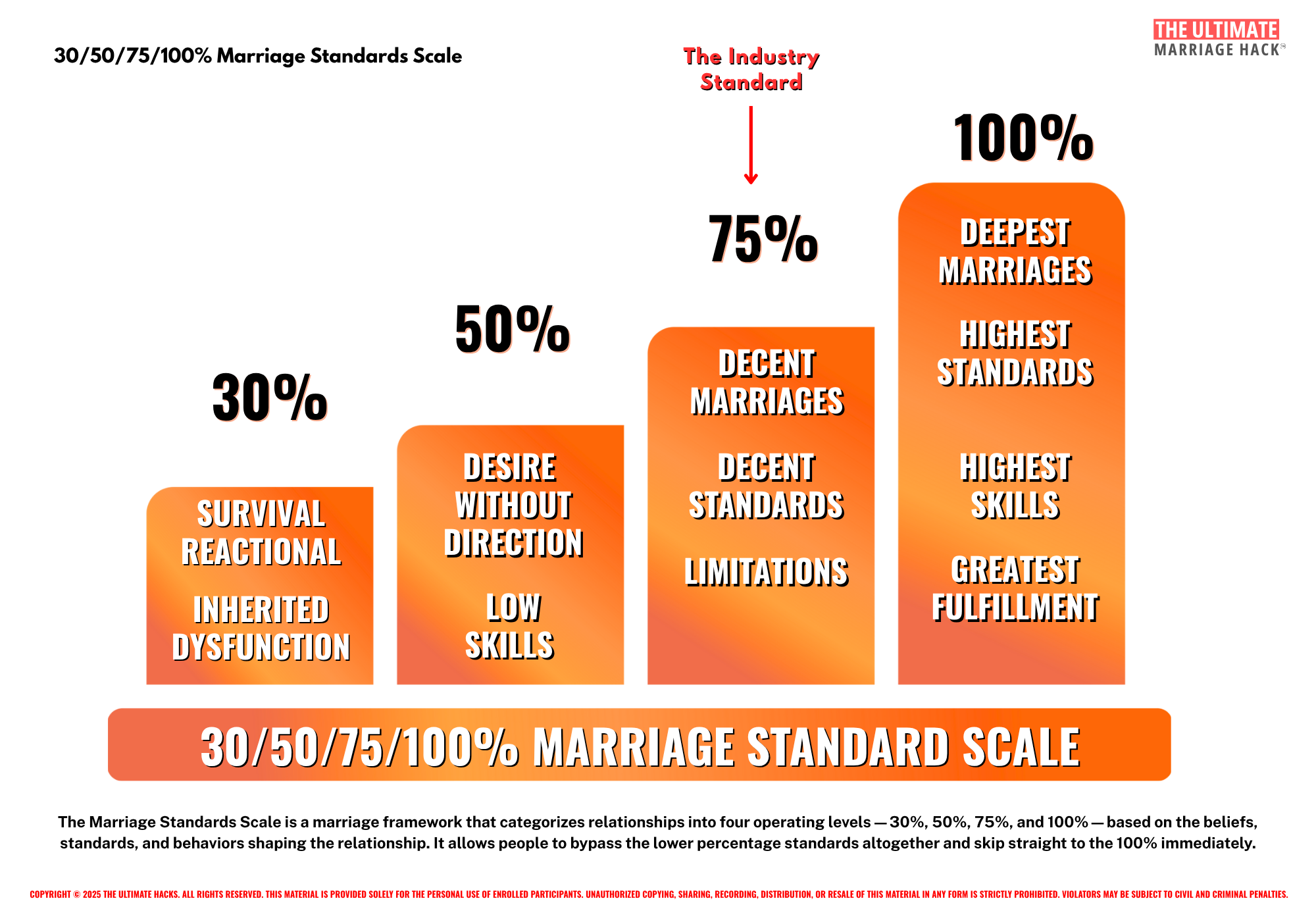
The Marriage Standards Scale is a marriage framework that categorizes relationships into four operating levels—30%, 50%, 75%, and 100%—based on the beliefs, standards, and behaviors shaping the relationship. The framework helps couples identify hidden operating systems that influence communication, intimacy, conflict, trust, and long-term marital outcomes.
The Marriage Standards Scale exists to make the invisible visible. Most people don't realize their marriage struggles are rarely random — they are often the result of inherited beliefs, learned behaviors, and normalized dysfunction passed down through family, culture, and society. This framework exposes those hidden standards so they can be confronted and changed.
The 30/50/75/100% Marriage Standards Scale is a framework for identifying the level of marriage you are currently operating from. It is not about achieving perfection. It is about aligning yourself to the highest standard and practicing those skills that allow you to experience the deepest marriage.
Why Marriage Standards Determine Marriage Outcomes
This matters because most marriage advice focuses almost entirely on behavior. It teaches communication tools, conflict strategies, boundaries, and emotional regulation. Those things matter, but they often focus on symptoms rather than root operating systems.
Behavior is downstream from beliefs.
Beliefs create standards.
Standards shape marriages. Your behaviors are a reflection of the standards you have chosen for your marriage.
Dr. John Gottman — one of the most cited marriage researchers in the world — identified what he calls "negative sentiment override": a state where resentment has built up and compounded so deeply that even neutral or positive actions from your spouse get filtered through a lens of suspicion, bitterness and read as negative. His research shows that contempt, stonewalling, and emotional disengagement keep couples locked in that state. His prescribed solution? Communication skills. Listen better. Try not to react. Take a break from the situation. Read the full Gottman Institute research here.
Those are not bad tools to manage the situation. But in terms of fixing your marriage problems and growth, they're incomplete. Because what we've observed is when resentment has compounded for years, communication skills are like spraying a garden hose on a house fire. The tool is not wrong. But the scale of the problem has outgrown it. What actually puts the fire out is cutting off the fuel source — the beliefs, the traps, the standards we choose that keep feeding the fire in the first place.
Two couples can face the exact same conflict, but their standards will determine how they interpret that conflict, how they respond to it, and whether it strengthens or weakens them. That is why the same advice works for one couple and fails for another. They are operating from different standards.
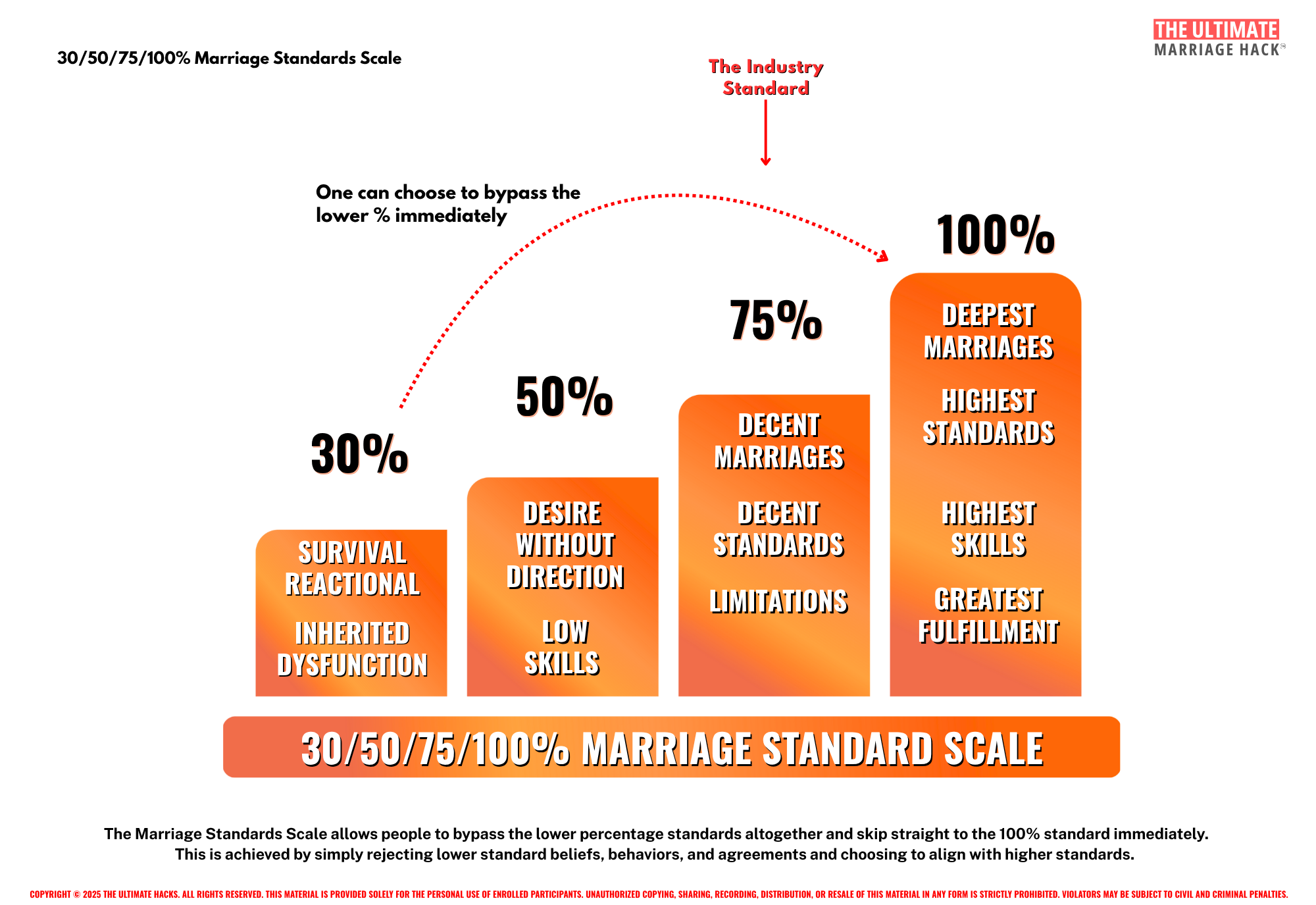
A 30% standard reflects survival-based beliefs and dysfunctions. A 50% standard reflects the desire to make relationships work, but without the tools or understanding to actually do it. A 75% standard reflects what society often teaches as the benchmark for a "good" marriage — functional on the outside, but often still carrying compromise, disconnection, and accepted dysfunction. And the 100% standard represents a Christ-centered design: God's full intention and blueprint for marriage.
The power of this framework is that it helps people identify where they are, recognize what shaped them, and realize there is a higher standard available. And the moment you see a higher standard, a new benchmark has been unlocked, and you can now choose to pursue that standard for your life.
The 30% Standard: Survival-Based Marriage
The 30% Standard is where marriage is driven primarily by survival, reaction, and inherited dysfunction. At this level, most people are operating from what they learned growing up rather than what they intentionally chose. Their understanding of marriage is often shaped by the environment they were raised in, and those early experiences become the blueprint they carry into adulthood.
I understand this personally. I grew up with the wrong role models, and for a long time, I thought cheating was normal. I thought broken homes were normal. I believed marriage was temporary, unstable, and full of betrayal because that was the environment I came from. When dysfunction surrounds you long enough, it stops looking dysfunctional. It simply becomes your ‘normal.’
That is the 'trap' caused by low standards.
This operating level is often formed in homes marked by abuse, addiction, abandonment, emotional neglect, betrayal, and instability. Those environments shape how people view trust, commitment, conflict, and love. Without realizing it, many adults carry this same system into their own relationships, repeating patterns they never consciously chose.
At this level, marriage often becomes highly reactive. Conflict escalates quickly, threats of leaving become common, and emotional regulation is weak. Past trauma continues to influence present decisions, making it difficult to build stability. The relationship itself often feels unstable because the standard underneath it is unstable.
Most people operating at the 30% Standard are not bad people. More often, they are wounded people operating from wounded levels that are keeping them trapped. And unless those levels are confronted and changed, they tend to repeat the cycle relationship after relationship and across generations.
The 50% Standard: Desire Without Direction
The 50% Standard is where awareness begins. This is the point where people start recognizing that something is broken. They feel the disconnect, they feel the pain, and they notice the same cycle repeating. At some point, they realize they do not want to keep living this way. That realization is important because desire matters.
But desire alone does not create transformation.
I was a lukewarm Christian for over a decade because I was trapped at a 50% standard. I had a great church with great people. Everyone knew they needed to change, but very few could show me real-life applications for how to change. So I kept doing what I knew best — staying in the same patterns while wanting different results. That frustration is the burden and motivation God gave us to create this scale.
At this standard, many couples begin trying harder. They read books, watch videos, go to counseling, listen to podcasts, and search for answers. Sometimes those efforts create improvement for a while. But many eventually fall back into the same comfortable patterns — not because they don't care, but because effort without clear systems often produces temporary progress instead of lasting transformation.
This is where many marriages remain, tangled in cycles of hope and disappointment. We want something "better," but we don't fully understand what "better" actually looks like. And no one can model a higher target if they don't know it exists.
That is the frustration of the 50% Standard.
The 75% Standard: Functional but Limited
I used to admire this standard. This was my target reference point growing up. But as I lived it out, I saw the truth—many of us spend our lives chasing our own needs, ambition, and validation while calling it marriage and success. We sleep next to each other but feel alone and unheard, sex becomes obligation instead of desire, and over time we stop being lovers and become roommates. Parenting often replaces partnership, and we pour ourselves into our children while our marriage quietly starves in the background. I lived like this for many years.
The 75% Standard is where most marriages stop, and that is what makes it so dangerous. This is the standard society often celebrates as success. The house is there, the kids are there, the careers and nice boats and cars, and the daily routines are there. From the outside, everything looks stable. And compared to the 30% and 50% Standards, it is.
But functionality and fulfillment are not the same thing.
At this level, many couples learn how to coexist well without ever achieving deep unity. They become efficient partners, decent parents, and stable teammates. Yet underneath that stability there is often emotional distance, quiet resentment, routine intimacy, and accepted disconnection. This is where phrases like "this is just how marriage is," "he/she is never going to change, we still love each other though" become common — and once that belief settles in, growth often stops.
The 75% Standard is reinforced everywhere. Movies normalize it. Friends normalize it. Culture normalizes it. The marriage industry teaches this as the benchmark for a healthy marriage.
But as we've seen in the above research by Gottman, they perform more like the garden hose on a house fire. This is why many marriages improve at this level without ever transforming into a better marriage. They become better at managing problems, but may never grow into the better marriage they desire.
Why Most Marriages Never Move Beyond the 75% Standard
The biggest difference between the 75% Standard and the 100% Standard is not effort — it's a higher calling.
Whether one believes it or not, marriage was not created by man — it was created by God. The world teaches marriage as a contract. But it's not a contract, it's a covenant. A contract is where two separate people try to make life work together. God teaches marriage as a covenant, where two become one flesh (Genesis 2:24; Matthew 19:5).
A contract says as long as you do your part, I'll do mine. But a covenant says: even though it costs me everything, I will remain faithful to you. That difference changes everything, because contracts are designed to protect individual interests, but covenants transform identity together.
The world says it is normal to check out other people as long as you do not physically cheat — but Jesus raised the standard and said if you lust after another, you've already committed adultery in your heart (Matthew 5:28). The world says love yourself, while God teaches sacrificial love (John 15:13; Ephesians 5:25).
The world says protect yourself, but God teaches die to yourself (Luke 9:23). The world says fulfillment comes from getting, while God teaches fulfillment comes through serving.
This is why the industry ceiling often stops at 75%: people never reach their full potential because their beliefs set lower standards, and lower standards always create lower ceilings.
Lower ceilings is why so many couples stay stuck—not because they aren’t trying, but because the tools they’re using often treat symptoms without addressing the deeper operating system. That’s also why many couples start questioning whether strong bible-based marriage coaching can be more effective than traditional therapy. You can read Is Online Marriage Coaching as Effective as In-Person Therapy?
The 100% Standard: Pursuing Deep Oneness and Unity
Now the 100%. This is the God standard of marriage.
Let's be clear: on this side of heaven, no one ever achieves the 100% standard — only Jesus was recorded in history to have never sinned (Hebrews 4:15). And scripture says we all fall short of the glory of God (Romans 3:23). But the 100% level is not about achieving perfection — it is about the pursuit of taking up our cross and following Christ (Matthew 16:24; Luke 9:23). That is where the life-changing excitement, love, and intimacy is!
The 100% standard marks the point where marriage shifts from two individuals trying to make it work, into one covenant system intentionally pursuing unity with each other and Christ. This is what scripture means when it speaks of becoming one flesh (Genesis 2:24). It is not simply living together or merely staying together. It is becoming 'one' in everything. One team. One mission. One person to have the most amazing love, sex and intimacy with for the rest of your life.
Here, husband and wife stop operating primarily from self-preservation and begin operating from shared identity. This shift changes everything (that management skills cannot) because when beliefs, identity, and standards change, behavior follows. Conflict becomes growth and refinement instead of division, and communication becomes clearer because defensiveness lowers.
Emotional disconnection and resentment loses power because connection with your spouse and Christ deepens. Rebuilding trust, communication problems, and parenting skills strengthen because unity becomes the priority. And marriage intimacy grows because oneness is being pursued intentionally — not 'whenever we can make time to.'
These couples aren't perfect by any means. They still struggle, they still fail, and they still face hard seasons. But their agreements are unwavering in those seasons. They strive to learn and practice skills that ensure the pursuit of godliness and purity are at the center of every decision.
Also, at the very core of it all, is love rooted in grace, forgiveness, and compassion that Jesus modeled for all to follow (1 John 4:11; Ephesians 4:32).
The 100% standard reflects biblical marriage standards rooted in covenant, sacrifice, unity, and Christ-centered love.
The First Time I Saw the 100% Standard
I will never forget the first time I saw this 100% standard lived out in real life.
A man named Mike Quinn was speaking on stage. He was an older guy, maybe 60–65 years old, and I was in my early 30s. He stood there talking about how much he loved his "smoking hot wife," and everyone laughed because of how charming and genuinely excited he was.
At that time, my reference point for men and marriage wasn't very high. I assumed he was an older man, newly married to some younger supermodel-type wife. Because that's what all the successful men whom I knew were calling "smoking hot."
Later, I saw them together on the patio. She was his same age and it turns out they were married for over 30 years.
As a 30 year old kid, I thought to myself, "She isn't smoking hot at all."
But as I watched them closely, the way they looked at each other, the way he held her by his side, the way she looked at him as he spoke — her eyes sparkled. The way he looked at her when she spoke — he looked like a boy in a candy store with his first love!
It was at that moment when I finally saw it. The true fairy tale love I always dreamed of was right there in front of me. They were the most 'smoking hottest' couple out there on that patio — no one was coming between them.
God finally revealed to me what the 100% highest marriage standard actually looked like — and I wanted it. And that moment unlocked a new reference point for me and I spent the next 15 years and $250,000 figuring out how to achieve it.
The Marriage Standards Scale Is Not a Ladder — You Can Skip to the Top
Now here's the great news: when most couples hear "the highest standard," they picture a long climb — 30%, 50%, 75%, and eventually reaching the 100%. This is not the case.
Yes, that was our story because we had no one to accelerate our learning curve. We had to live through the consequences of lower standards, learn through pain, and slowly uncover what God's design actually looked like. But that doesn't have to be your story where you risk it all like we did.
These are not stages of progression — they are operating levels of agreement. They represent the beliefs, values, and behaviors you are currently agreeing to live by in your marriage, and the moment you see a higher standard, you can choose and start practicing that level immediately. Remember, the 30/50/75/100% Marriage Standard Scale exists to make the invisible visible.
A couple at a 30% does not need to spend years to learn the 50%. And a couple stuck at a 50% does not need to slowly work their way into 75% patterns. The purpose of the scale is not to keep couples moving through stages, but to help them identify the lower standards they are currently living by so they can replace them with higher ones.
This is why we call it The ULTIMATE Marriage Hack™ — not because it offers shortcuts, but because it allows people to bypass the lower percentage levels altogether and skip straight to the top.
That doesn't mean you will master it overnight, or that years of trauma, dysfunction, or poor habits disappear in a day, but it does mean the trajectory of your life can change in a moment. Remember: before behaviors really change, beliefs must change. Before habits change, standards must change. Before the fruit changes, the connection to the vine must change (John 15:5).
You do not have to climb your way to start pursuing the 100% — you simply have to reject what is lower and agree to pursue what is higher, and that choice can happen immediately.
Why the 100% Standard Is Easier Than Lower Standards
When most couples hear "the highest standard," they assume it must be the hardest path. This is one of the biggest misunderstandings about the 30/50/75/100% Marriage Standard Scale.
What we've observed over the years with couples is that this framework is so powerful because of the paradox at its center: the 100% standard is often easier to live than the 75% standard. At first, that sounds backwards, but the reason is simple.
A 30% marriage is exhausting because it is filled with chaos, instability, distrust, and repeated damage. A 50% marriage is exhausting because it is filled with confusion, inconsistency, and the endless frustration of wanting change without knowing how to do it. A 75% marriage standard is exhausting because it often carries worldly goals and views that increase stress and anxiety. Cultivating hidden resentment, quiet loneliness, emotional distance, sexual disconnection, and years of compromise that slowly wear people down and force them to settle in life.
The lower 75% standards keep couples focused on managing their differences. Much of the world's well-meant relationship advice teaches couples how to cope, negotiate, tolerate, and manage the space between two people who often want different things. Even many churches will unknowingly teach this standard, perhaps thinking it's the safe option, "If the institutions and experts teach it, it must be the best… right?" The goal becomes maintaining theoretical 'peace' while accepting compromise as the best possible outcome. This is the core problem we break down in depth in our article, The Marriage Hack Everyone's Citing — And Why It Only Manages The Problems.
You don't have to settle for that. Yes, the 100% agreement requires more intentionality upfront, but it removes so much unnecessary suffering on the backend. When husband and wife are aligned, operating as one, and pursuing God's design together, marriage becomes a place of peace instead of pressure. Trust grows deeper. Communication becomes safer. Intimacy becomes exciting instead of forced. You feel seen, safe, and fully appreciated. The hardships in life become opportunities to model unwavering unity for our children to see in real time.
The work is simpler but the result is freedom from the cycles that kept us trapped.
Over the years, we've observed that when couples practice the top transformational skills that foster the 100% marriage they stop practicing almost every management skill they learned before.
Why More Faith Alone Doesn't Determine Marriage Outcomes
More faith alone does not determine the strength of a marriage. A willingness for obedience is needed. Yes, pursuing the 100% standard cannot be achieved without faith in Jesus Christ. Period. hroughout Scripture, God uses people to accomplish His will. Yet many Christians ask God for help while rejecting the very help He sends because it conflicts with their own standards, assumptions, or expectations about what that help should look like.
For example, two couples can share the same commitment to faith but live by different marriage standards and produce completely different outcomes. The difference is not whether they believe in God. The difference is the standard they have agreed to live by and the skills they choose to practice daily.
Some couples remain committed to God while willingly or unknowingly operating from lower marriage beliefs and patterns that keep them in constant struggle. Others choose a higher standard early on and build the skills to match it: communicating under pressure, repairing conflict, pursuing unity, practicing humility, and choosing obedience over pride. Because of that shift, their marriage produces stronger fruit much sooner.
This principle is reflected in Scripture: “Faith by itself, if it is not accompanied by action, is dead” (James 2:17). Genuine faith produces movement. It changes how we think, how we respond, and what we are willing to do in obedience to God.
In the same way, faith alone does not transform a marriage if it is never expressed through growth, humility, repentance, and action. While faith in Jesus Christ is essential, transformation requires a willingness to align our beliefs, behaviors, and standards with His.
If we reject opportunities for growth because they challenge our existing standards, preferences, or assumptions, then we are not simply rejecting the growth itself. We may be choosing our standard over God's standard. True transformation begins when we surrender our way and embrace His.
This is the foundation of why we created the Marriage Standards Scale. I spent years as a lukewarm Christian, not because I lacked belief in Jesus, but because I did not understand the difference between having faith and living under God’s standard in practice. I did not know how to choose the higher level or build the skills that would actually express it.
Over time, I learned that faith without the willingness to grow, surrender lower standards, and practice higher skills can leave people stuck in cycles despite sincere devotion. Our mission is to help Christians bridge that gap: from belief to practice, from lower standards to God’s standard, and from marriage management to true transformation.
Final Thoughts
Many couples spend years trying to improve their marriage without first identifying the healthy marriage standards they are actually pursuing.
The 30/50/75/100% Marriage Standards Scale was created to make the invisible visible. Because most marriage struggles are not random. They are often the result of inherited beliefs, learned behaviors, and accepted standards that have been practiced for years without ever being questioned.
What you cannot see, you cannot change. That is why this marriage standards framework exists. It helps you identify the levels you are currently living by, recognize what shaped them, and understand that there is a higher agreement you can choose.
Not a worldly standard. Not a culturally accepted standard. But a Christ-centered marriage designed to experience the deepest love, intimacy, and connection with your spouse.
The goal of this framework is not to label people. It is to reveal the hidden formations and agreements that may be shaping your marriage, your family, and your future.
Because once those standards become visible, they can be challenged. And once they are challenged, they can be changed for good.
Unlike cultural expectations that constantly shift, Christian marriage standards provide a stable foundation for long-term intimacy and unity.
The 100% marriage agreement is not about perfection. It is about alignment. And alignment with Jesus’ way always produces stronger marriages, healthier families, and better outcomes for future generations.
We love you and are rooting for your marriage.
So where does your marriage actually stand?
Not where it looks like it stands. Not what you tell other people. But what’s true behind closed doors.
Are you deeply connected—or just coexisting?
Are you building intimacy—or managing distance?
Are you partners—or have you quietly become roommates?
The standard you live by determines the marriage you build.
And if you’re realizing something feels off, the next step is understanding what a Marriage Hack actually is—and why it may be the missing framework your marriage needs.
Read the next article: What Is a Marriage Hack?
FAQ: Marriage Standards Scale
What is the Marriage Standards Scale? The Marriage Standards Scale is a framework that helps identify the underlying standards a marriage is operating on by revealing the beliefs, behaviors, and expectations that shape relational outcomes over time. It exists to make the invisible visible for you.
What do the 30%, 50%, 75%, and 100% standards mean? The percentages represent levels of alignment with a Christ-centered marriage standard. Lower levels reflect reactive or self-focused patterns, while higher levels reflect covenant-based alignment built on honor, sacrifice, unity, and responsibility.
Why is the Marriage Standards Scale important? It is important because most marriage problems come from unseen standards rather than isolated issues. The framework makes those hidden patterns visible so they can be understood and changed at the root level.
Is the Marriage Standards Scale a form of therapy or counseling? No. It is not therapy or counseling. It is a standards-based awareness framework designed to help couples evaluate the operating system of their marriage and identify what is producing their current relational outcomes.
Can a marriage move from a lower percentage to a higher one? Yes. A marriage can skip to any level through consistent changes in beliefs, behaviors, and standards. We've helped couples skip from 30% bordering divorce to pursuing 100% intimacy and love in 2-4 weeks.
Is 100% on the Marriage Standards Scale about perfection? No. 100% does not represent perfection. It represents pursuing full alignment with a Christ-centered covenant standard built on unity, sacrifice, honor, and commitment rather than cultural or self-centered norms.
Maddox Vic & Stephanie Sripetch are the creators of The ULTIMATE Marriage Hack™. Everything they teach comes from lived experiences, life epiphanies, and Godly revelation
Got a Question You're Too Afraid to Ask?
We created our Asking for a Friend™ Series for exactly that reason — because the questions people are most afraid to say out loud are usually the ones that matter most.
Every episode, we answer real questions from real couples. No judgment. No shame. Just honest answers from people who've been there.
Have a specific question you want us to answer? Let us know. We read everything.
📧 [email protected] 📱 Instagram: @the_ultimate_hack | @MaddoxVicOfficial
Connect With Us
Thank you for reading.
Our mission is simple: to help couples experience deeper unity, stronger intimacy, lasting harmony fast.
If this article helped you, we'd love to here how it helped. Tell us at.
Instagram: @MaddoxVicOfficial
Youtube: @MaddoxVicOfficial
Facebook: https://www.facebook.com/vic.sripetch
Website: https://theultimatemarriagehack.com/
Support Email: [email protected]
For additional marriage resources, articles, training, and coaching opportunities, explore the rest of The ULTIMATE Marriage Hack™ Knowledge Base.
We're rooting for your marriage.
— Maddox Vic & Stephanie Sripetch
The ULTIMATE Marriage Hack™