The Marriage Hack Everyone's Citing — And Why It Only Manages The Problems
If you've searched "marriage hack," you've probably landed on a page explaining a 2013 psychology study. We're going to talk about that study too — fairly, and with the actual research linked so you can read it yourself. But we also want to tell you what we learned the hard way. We spent twenty years and over $250,000 on five therapists, many coaches, mentors, pastors, and high-value clients. Somewhere in that process, we noticed something: every skill we were taught just helped us manage our problems. None of it got rid of them. That's when we started asking a different question entirely: how do you stop having so many problems in the first place?
We are not relationship experts with framed degrees on the wall. We are you, five, ten, fifteen years ago. We wanted more out of our marriage. We just didn't know what "more" even looked like, and we quietly feared that maybe mediocrity was just what marriage was supposed to feel like. So we spent two decades and a small fortune learning a lot of mediocre, well-meaning advice. Buried inside it was a handful of genuinely great insights, pulled from psychology, business, sports, theology, and people who were actually living what they taught. We took only the very best of it, combined those pieces together, and got rid of the majority that was just mediocre, well-meaning noise. That's what we teach now — and it means the families we work with get to skip years of trial and error. They get all the wisdom, and none of the scars. We're not sharing this because we figured out something no one else knows. We're sharing it because God showed us something we wish someone had shown us twenty years and $250,000 sooner. It would feel wrong to keep it to ourselves.
Here's the question that started all of it, the one we asked in session after session, with therapist after therapist:
"I don't want to manage the problem. How do I stop having the problem come up in the first place?"
For years, almost no one could answer that. Only a few of the very best — the ones actually practicing the highest standard themselves — ever could.
To be clear before we go any further: if therapy is working for you, that's wonderful, and we mean that. Our goal here isn't to tear down good, well-meaning therapists and counselors. It's to lift them up — to help the whole field reach for the highest standard, the same way we're asking couples to.
Is the marriage hack the same thing as marriage counseling? Not quite — and that difference is the whole reason we're writing this.
What Is the Marriage Hack Study? (Finkel's 2013 Research Explained)
Let's start with the research, because it's real, it's well-designed, and it deserves a fair hearing before we tell you where we think it falls short.
In 2013, Eli Finkel and a team of researchers published a study in Psychological Science. The study was called "A Brief Intervention to Promote Conflict Reappraisal Preserves Marital Quality Over Time," and the team included researchers from Northwestern, Villanova, Redeemer University, and Stanford. They followed 120 couples for two years. The goal was to test a 21-minute exercise designed to help couples reframe their conflicts. Half the couples were randomly assigned to try the exercise in year two. The other half were not.
The exercise itself was simple. Couples thought back on a specific disagreement. Then they imagined how a neutral third party, someone who wanted the best for everyone, might see that same disagreement. They thought about what made that outside view hard to hold onto. Over the following months, they practiced returning to that third-party perspective during real arguments.
Both groups got less happy with their marriage during year one. That's normal — most couples' satisfaction naturally fades a bit over time. But here's the real finding: in year two, that decline kept going for the couples who didn't do the exercise. For the couples who did, the decline stopped completely. Critically — and this is a detail most pages summarizing this study skip — the exercise didn't increase relationship quality. It just may have helped it stop getting worse. The researchers found this worked by reducing how upset couples felt during conflict, not by fixing the issues that caused the conflict in the first place.
You can read the full study and citation yourself here: Finkel, Slotter, Luchies, Walton, & Gross (2013), Psychological Science, DOI: 10.1177/0956797612474938. Psychology Today also has a clear, accessible breakdown if you want it explained in plainer language.
Does the Marriage Hack Actually Work? (Strengths and Limits of the Study)
We want to be honest about something: this is good research. It's randomized, it's peer-reviewed, and it tracked real couples for two real years. That's not a weekend retreat with a satisfaction survey at the end. Say your marriage is fundamentally healthy. Maybe you just need a tool to interrupt a downward spiral during an argument — a pause button before things get said that can't be unsaid. For that, this works. We don't think that's nothing.
Even Finkel himself draws this boundary. In comments reported by TODAY, he cautioned that these kinds of brief interventions "won't turn a bad relationship into a good one." He also said they aren't meant for situations where someone is in danger of being abused. That matters. It means the gap we're about to describe isn't us reading too much into a study. It's the study's own author admitting its ceiling.
We also want to say plainly: other sites covering this topic, like Patricia Morgan's breakdown of the same study and Portland Therapy Center's, explain the mechanics accurately. We're not here to argue the science is wrong. We're here to argue it's incomplete — and that the gap matters more than most couples realize until they've spent years living inside it.
Why the Marriage Hack Doesn't Fix the Root Problem
Here's the epiphany that took us years and a lot of money to reach, and it didn't come from one bad session — it came from a pattern we kept noticing across dozens of conversations, with multiple therapists, over multiple years.
In couples therapy, there's a foundational concept the field itself teaches: the couple is the client, not either individual person on their own. A past president of the International Association of Marriage and Family Counselors has put it directly. Too many people assume couples counseling is just individual counseling done twice in the same room. But that's not how the field actually works. The relationship itself is what's being treated and preserved.
That sounds reasonable. But once you see it, you start noticing what it actually produces. It pulls toward managing conflict instead of changing what someone believes. If the relationship is the client, the goal becomes keeping that relationship intact and working. It's not about asking whether either spouse needs to become a different person. Reappraisal, communication scripts, compromise frameworks — they're all aimed at the same target. Reduce the friction. Preserve the system. Stop the bleeding.
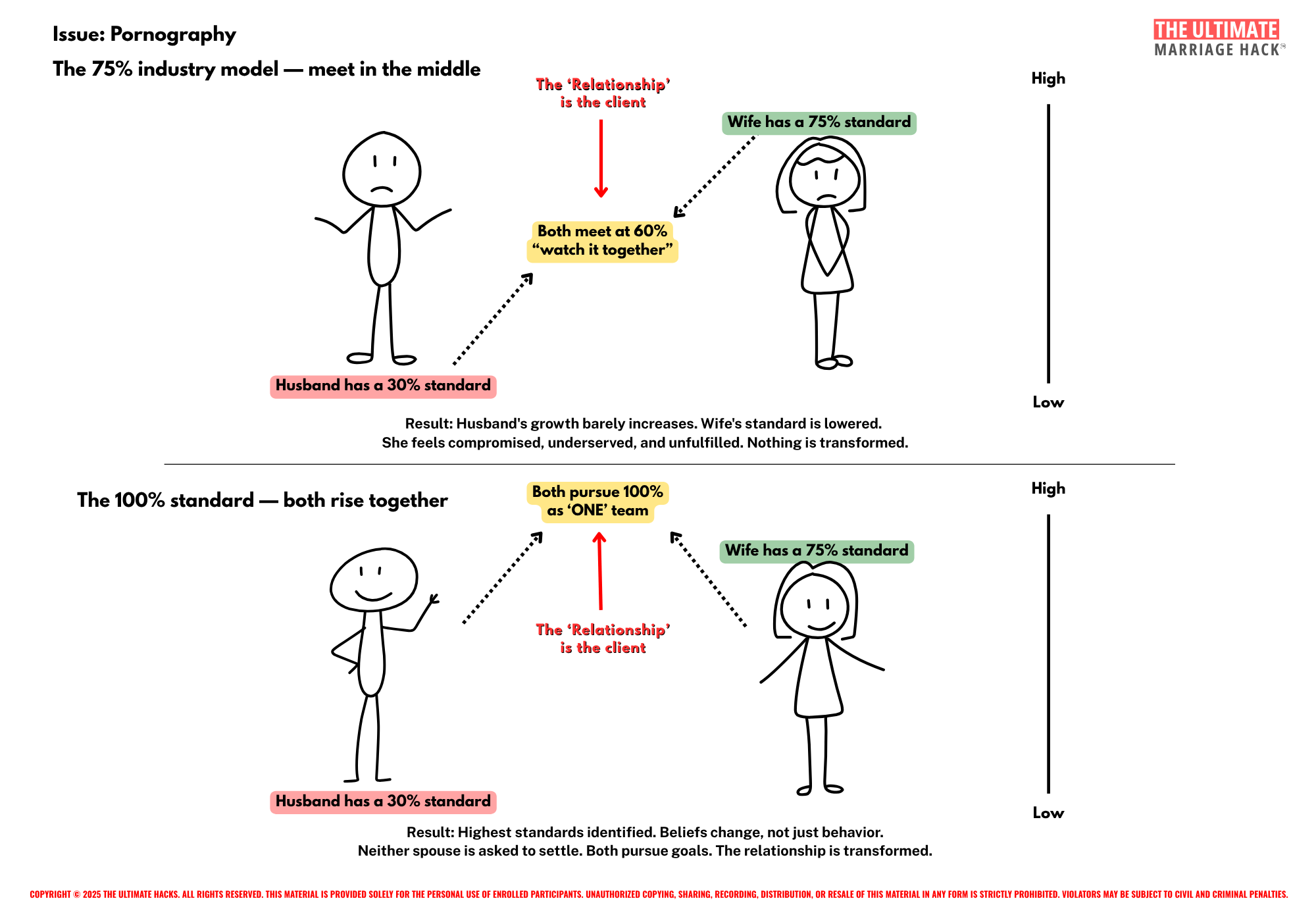
We learned this firsthand. Years ago, in counseling with a strong, sincere Christian therapist, the topic of pornography came up. I'd grown up watching it since I was a child — it was just normal in my world, something everyone around me did without a second thought. Stephanie had higher standards. She felt disrespected by it, like a quiet form of emotional cheating and betrayal. The therapist's solution was a compromise: what if I invited Stephanie to watch with me, and in exchange I scaled back my private usage? My standard would rise a little. Her standard would lower a little. We'd meet in the middle.
At the time, that sounded almost reasonable. It took me a year to understand what actually bothered me about it: she never told me it was wrong. Not because she didn't know — because the model she'd been trained in wasn't built to say that. It was built to find equilibrium between two competing standards, not to ask which standard was actually true. This is why many people start questioning whether strong bible-based marriage coaching can be more effective than traditional therapy. You can read Is Online Marriage Coaching as Effective as In-Person Therapy?
That was the moment the pattern clicked into focus. Every issue we brought into therapy — porn, parenting differences, the way we spoke to each other, how much we each wanted to grow — got run through the same machine: find the midpoint, negotiate the compromise, manage the friction. We never once left a session having asked: how do we get rid of this problem at the root, permanently, instead of getting better at living with it?
And lust and porn weren't the only place we saw it. Once you learn the The 30/50/75/100% Marriage Standards Scale, you recognize the patterns show up everywhere a couple has ever sat across from a counselor's desk. Money is a common one. One spouse wants to save and plan years ahead. The other wants to enjoy today. The usual "75% fix" is a budget compromise that leaves the saver anxious and the spender resentful. Sex and intimacy follow the same shape — differing desire levels get negotiated into a "fair" middle frequency that quietly satisfies neither person. The same goes for parenting philosophy, in-laws and extended family boundaries, anger and conflict style, how much faith actually shows up in daily life, and the pace either spouse wants to grow at. We've coached couples through all of it. It's always the same machine running underneath. Somebody's standard is higher. Somebody's is lower. And the "75% fix" was built to find the midpoint instead of asking which standard was right all along.
That's why the lust and porn story and the story you're about to read aren't really about lust, porn, or disrespectful tone. They're both just clear windows we have into patterns that touch every single issue a marriage faces.
The 75% Standard vs. The 100% Standard, Explained
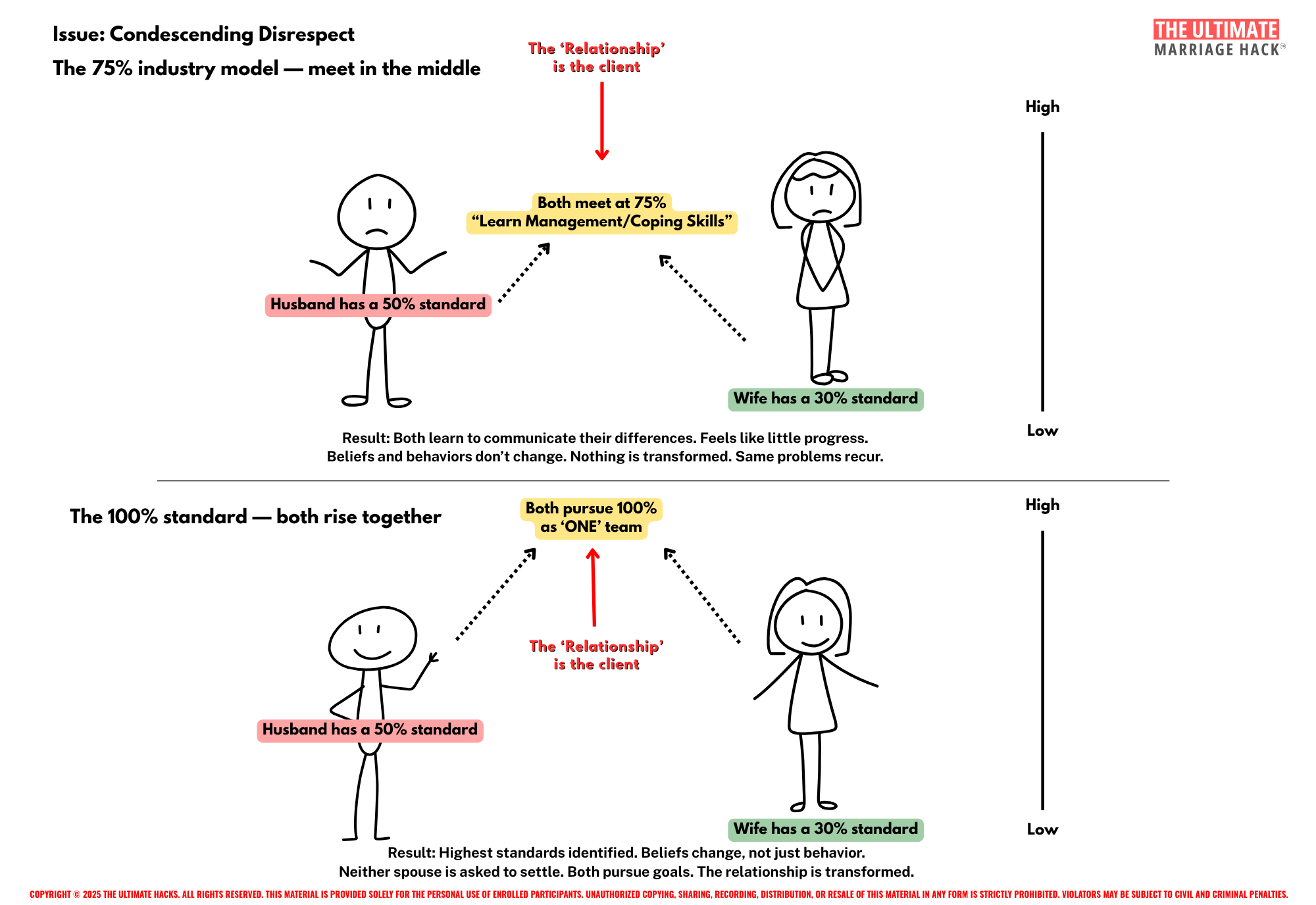
We illustrate this for couples on a whiteboard now, because once you see it, you can't stop seeing it everywhere. Picture two stick figures — a husband and a wife. Draw a bar next to each one representing their standard on a given issue. One spouse's bar is low. The other's is high.
The 75% industry model resolves this by pulling both bars toward the middle. The lower spouse rises a little. The higher spouse is asked to lower their expectation to meet them. Couples are told this compromise is what a healthy, harmonious marriage looks like.
It isn't. Because the spouse who had to lower their standard doesn't feel like they reached harmony — they feel compromised, underserved, and unfulfilled. Their desire for something better wasn't met; it was talked down. That doesn't disappear. It compounds into quiet resentment, the kind that doesn't show up as a fight but shows up as distance.
We saw this exact pattern in ourselves, and in nearly every couple we've coached. Here's one example — we'll keep this couple anonymous, since we want to protect their privacy. Both husband and wife had spent years in therapy and self-help, each learning their own version of softer words and better delivery. They both got better at the words. But the contempt and resentment underneath never moved for either of them, because nothing had addressed the beliefs driving it — only the behavior on top.
We saw the opposite happen with Lis. She'd spent years being told, essentially, to phrase her frustration more kindly. It helped a little. But it was only once she went through our Heroic Women™ course and saw, in concrete terms, the kind of woman she actually wanted to become, that something shifted. In her own words: "We all know not to speak badly or down to our husbands, but I could never do that before. But after Heroic Women and learning the life hacks, I now know what kind of woman I want to be. So now I can. Clearly these life hacks work."
That's the entire difference in one sentence. Lis didn't get better at managing her tone. She became a different person, and the old behavior had no more foundation to stand on. Both she and her husband began believing in, speaking to, and lifting each other up toward the 100% standard they wanted to reach together within the first week.
Why Small Marriage Problems Feel Like Big Ones (And How to Stop It)
There's a mechanism underneath all of this that we didn't fully understand until we lived through it ourselves.
I grew up with a deep fear of abandonment and self-sabotaging tendencies — my father left when I was a baby. When I was a child, I went to go live with him. He told me that if I didn't love his business, I didn't love him. So I ran away. My first serious relationship ended when she cheated on me, something I'd predicted before it happened, and then watched her lie about it for a year. By the time I met Stephanie, I had a pattern: push away the people who loved me before they could leave first. I cheated on her twice. We signed divorce papers within our first three years of marriage.
In therapy, we'd bring in what felt like small things — how we loaded the dishwasher, our different parenting styles, the offhand comment that "I wouldn't have handled it that way." We'd learn communication tools to talk through them. We'd compromise. But none of it touched the actual problem, which was that when you're disconnected from your spouse, every small disagreement starts to feel like proof you're incompatible. An anthill becomes a mountain. EMDR didn't resolve the fear underneath it. Years of communication coaching didn't either.
What changed everything wasn't a better argument-management technique. It was both of us anchoring to the same 100% God standard — one mission, one team, pursuing the same goal for ourselves, our marriage, and our children. Once that happened, two things shifted. First, the small anthill issues stopped mattering, because we were so aligned on the things that actually counted. Second — and this surprised us — the fear of abandonment that had driven my entire adult life quietly closed. Not because Stephanie promised never to leave. Because a person who invests that much heart, time, and effort into becoming one team with you isn't someone with one foot out the door. The commitment itself became the evidence. And the bond we formed filled holes in the heart that God promises He can fill.
What Is the 100% Standard? Marriage Transformation vs. Marriage Management
The industry standard — what we call the Lower 75% model — teaches couples to become better versions of themselves. Slightly improved. Slightly more compromised. Still fundamentally the same two people, just with smoother edges.
What we teach is different in kind, not degree, because Scripture doesn't call us to become a "better version" of ourselves. It calls us to die to self and become a new creation in Christ. That's what we mean when we say being transformed by the renewing of your mind — not self-improvement, but a genuine new creation. It's the actual meaning, we believe, behind two becoming one flesh: not two people who've learned to tolerate each other's gaps, but two people pursuing the same highest standard together, growing in the same direction, at the same time, for the same reasons.
That's the gap the famous 21-minute study was never built to close, and even its own author would tell you so. It can help you stop the bleeding. It cannot give two people a shared destination in pursuit of the highest standard.
A Licensed Therapist's Experience With the 100% Standard
We've heard this from clients. We've heard it from couples we've coached personally. But maybe the most striking version of this came from John B., a licensed therapist, counselor, and coach who went through our Heroic Men™ program.
In his own words: "When I learned about the 30/50/75/100% marriage standards, I thought I was higher, but in Heroic Men™ I resonated more with 50 percenters — the way I was living my life for 50 years. I never thought I could aim for higher. Now today, I know what kind of man I want to be and I'm practicing the 100% standard when I work with children, parents, my business, even in my personal life. Now I recognize, I used to give 50 percenter advice to people — 'you're young,' 'live your life, have fun.' But today I guide them toward the 100% standard. I ask them, 'Five years from now, what kind of man or woman do you see yourself as, and is this decision going to help you get there?' Let me show you how your decisions today impact your life in the future."
A licensed professional, trained in the very field this post has been examining, recognized the ceiling in his own life and his own advice to clients — and recognized it from the inside. That's not a coincidence. That's the gap we've been describing the whole time, seen from the other side of the therapist's chair.
So back to the question that started all of this: how do you stop having so many problems in the first place? Not by abandoning the research. Not by walking away from therapy, either — which has real value. Like we said at the start, our goal isn't to tear down the good, well-meaning people doing this work. It's to lift the whole industry higher, the same way John B. lifted his own practice once he saw the 100% standard. For us, the answer came from refusing to settle for managing what God never intended for us to just manage. We spent twenty years and over $250,000 learning that lesson the hard way. We traded our money, our time, and almost our marriage to find it. That's why we built The ULTIMATE Marriage Hack™. So the next couple doesn't have to risk what we risked. They don't have to waste what we wasted, or wait as long as we waited, to find the same answers. We love you and are rooting for your marriage.
If you want to see what pursuing that standard actually looks like in practice, we've laid it out in Heroic Men™ and Heroic Women™.